
The Code Built to Last: Why Bitcoin's C++ Foundation Outlives the Hype.
In an Era of Ephemeral Frameworks, the World’s Most Secure Coin Relies on the Unforgiving Discipline of Systems Architecture.
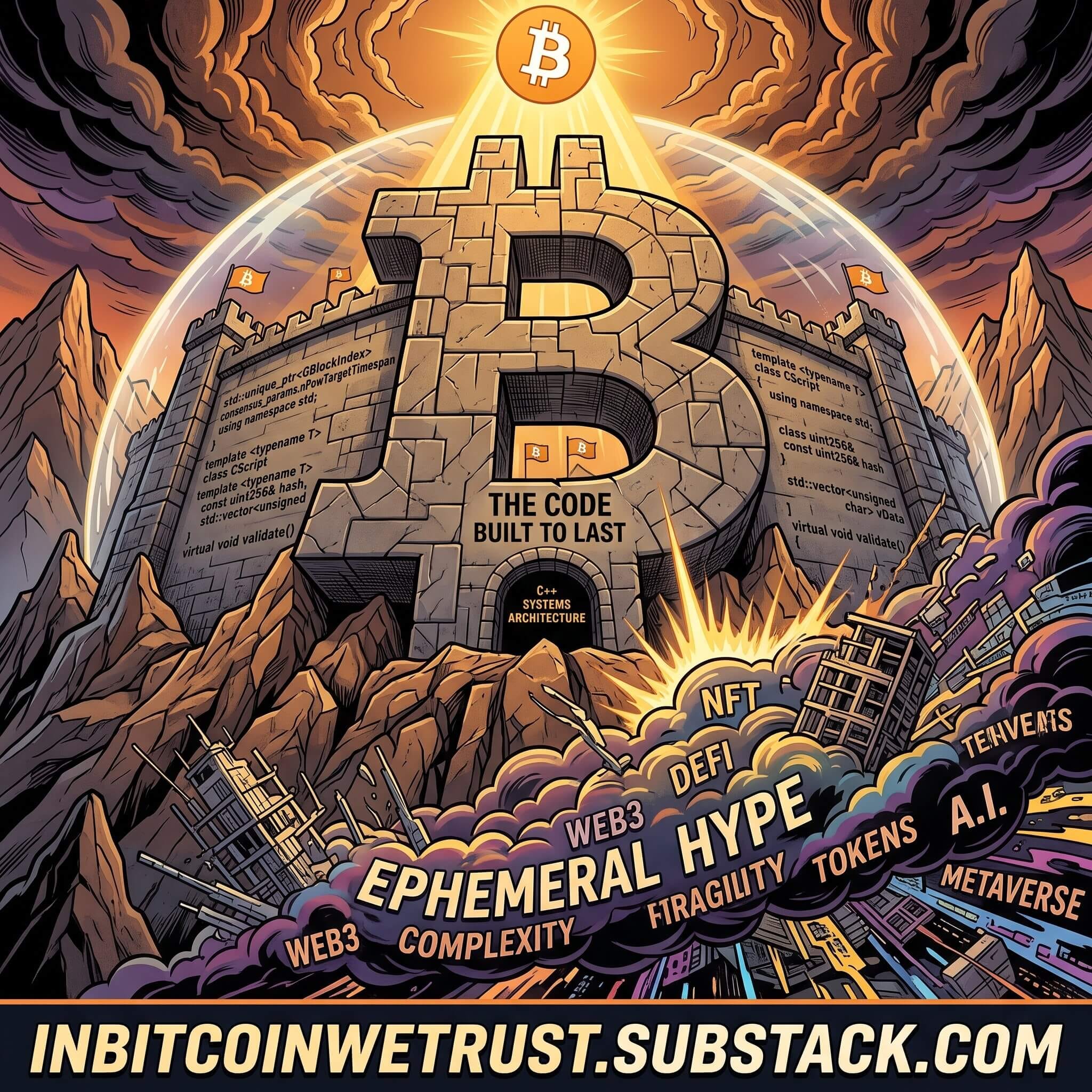
Walk into any modern Silicon Valley startup today, and you will find an environment obsessed with velocity. The mantra of the past decade has been “move fast and break things.” Software engineering has increasingly become an exercise in abstraction, moving further and further away from the bare metal of the machine. We build applications inside containers, which run inside virtual machines, which are managed by automated orchestrators in the cloud.
This relentless pursuit of speed and abstraction has undeniably revolutionized the digital world. It allows for rapid iteration, continuous deployment, and the ability to scale web applications to millions of users in days. But when you are building the foundational layer of a new global monetary system, “moving fast and breaking things” is not a strategy. It is a catastrophic liability.
In the software industry, frameworks rise and fall with the seasons. A technology stack that was considered the bleeding edge five years ago is often deemed obsolete today. Yet, the most secure, resilient, and valuable monetary network on earth operates on architectural principles established decades ago, anchored in the C++ programming language.
To truly understand Bitcoin, one must look beyond the macroeconomic shifts, the central bank interventions, and the daily price action. One must look at the code. The architecture of Bitcoin Core is a masterclass in technical restraint, defensive programming, and the stoic refusal to compromise security for convenience.
The $8 Billion Mirage: Why Shorting Bitcoin to Death is a Fantasy.

It is completely natural and legitimate to harbor doubts about the longevity of digital assets, especially when an academic authority points out potential flaws. Since its genesis in 2009, the Bitcoin network has been declared “dead” hundreds of times by economists, central bankers, and cybersecurity experts. Yet, Satoshi Nakamoto’s creation continues t…
The Software Ephemera of the 21st Century
To appreciate the gravity of Bitcoin’s technical foundation, we have to contextualize it within the broader landscape of modern software development. Over the last two decades, the evolution of programming languages has heavily favored developer ergonomics. The goal has been to make coding easier, faster, and more accessible.
Languages like Python have democratized data science and automation through their incredible readability and massive ecosystems of pre-built libraries. PHP powered the early dynamic web, allowing anyone to stitch together a functional database-driven site with minimal friction. Java introduced the concept of “write once, run anywhere,” utilizing the Java Virtual Machine (JVM) to handle the complexities of memory allocation and platform-specific compilation.
These tools are incredibly powerful. Having spent over two decades writing, debugging, and architecting software across C, C++, Java, PHP, and Python, I have seen firsthand how each language serves its specific domain. You use Python for rapid prototyping and AI modeling. You use PHP or Java for web backends and enterprise middleware. They abstract away the hardware, handling the “plumbing” so the developer can focus purely on business logic.
But this convenience comes at a hidden cost: a lack of absolute deterministic control.
When a garbage collector in Java pauses execution to free up memory, or when Python dynamically assigns variable types at runtime, the developer is ceding control to the environment. In 99% of software applications, this trade-off is entirely acceptable. If a web page takes an extra 200 milliseconds to load, or if a microservice requires a daily reboot due to a minor memory leak, the business continues to function.
Bitcoin is the 1%.
In a decentralized peer-to-peer network responsible for securing hundreds of billions of dollars in hard value, there is no room for abstraction errors, non-deterministic execution, or garbage collection pauses. The code must interact with the machine with absolute precision. This is why the foundation of Bitcoin was not built on the transient frameworks of the web, but on the unforgiving bedrock of systems engineering.
The Immutability of a Coin vs. The Fragility of a Token
Before diving deeper into the architecture, it is necessary to make a vital categorical distinction that the broader cryptocurrency industry often intentionally blurs: Bitcoin is not a token; it is a coin.
This is not mere semantics. It is a fundamental architectural reality.
A token is a digital asset created and managed by a smart contract running on top of a pre-existing platform. When you interact with a token, you are asking a third-party virtual machine to update a ledger entry within a broader, complex software environment. Tokens inherit all the vulnerabilities, complexities, and upgrade risks of the platform they reside on. They are subject to the whims of the platform’s developers, the shifting rules of the protocol’s consensus, and the often-fragile nature of Turing-complete smart contracts.
A coin, conversely, is the native asset of its own independent blockchain. Bitcoin exists as the base layer. It relies on nothing else. Its rules are entirely self-contained within its own unyielding consensus mechanism.
The proliferation of thousands of tokens over the last several years is a symptom of the “move fast and break things” mentality applied to money. Developers use highly abstracted, web-like languages to deploy complex financial instruments in minutes. The predictable result has been billions of dollars lost to smart contract exploits, platform reboots, and compromised centralized bridges.
By remaining a native, fiercely independent coin, Bitcoin isolates itself from the systemic risks of decentralized finance (DeFi) platforms. Its architecture is deliberately rigid. It does not exist to support a sprawling ecosystem of decentralized applications; it exists to be money. This singular focus allows its codebase to remain uniquely secure.
The Mempool Wars: How Cluster Mempool Could Rewrite Bitcoin Fee Markets.

Bitcoin fees are not just “high” or “low.”
C++: The Crucible of Systems Engineering
When Satoshi Nakamoto released the first version of the Bitcoin software in 2009, it was written in C++. Some have argued over the years that this was simply a byproduct of the era, or that if Satoshi were building Bitcoin today, he might choose a newer systems language like Rust. While the Rust vs. C++ debate is valid for future iterations of software, the legacy of C++ in Bitcoin Core is a critical component of its survival.
C++ is not a language that holds your hand. It is notorious for its steep learning curve and its absolute lack of safety nets. Unlike Python or Java, C++ requires manual memory management. The developer must explicitly allocate memory when an object is created and explicitly destroy it when it is no longer needed. If a developer fails to do this correctly, the program will suffer from memory leaks, segmentation faults, or buffer overflows—vulnerabilities that can easily be exploited by malicious actors.
Why, then, use such an unforgiving language for a system that demands perfect security?
Because C++ forces rigor. It acts as a crucible that burns away sloppy programming. When you build in C++, you are forced to understand exactly what the hardware is doing at every clock cycle. You must understand how memory is laid out, how the CPU caches data, and how concurrent threads interact.
Furthermore, C++ provides unparalleled performance and resource efficiency. A Bitcoin node must process every single transaction and validate every single block since the genesis block. It must do this while communicating with dozens of other peers over the network, verifying complex cryptographic signatures in milliseconds. C++ allows the Bitcoin Core software to run efficiently on low-powered hardware—even a basic Raspberry Pi.
This efficiency is not just a technical bonus; it is a macroeconomic necessity. For Bitcoin to remain truly decentralized, the cost of running a fully validating node must remain low enough that everyday individuals can participate. If the software were bloated, requiring enterprise-grade servers to process the chain, the network would rapidly centralize in data centers, destroying the very sovereignty the network was designed to provide. C++ ensures that the barrier to entry for verifying the network remains accessible to the individual.
Determinism and the Danger of the Undefined
The most critical requirement of the Bitcoin network is consensus. Every node on the network, no matter where it is located or what hardware it is running on, must arrive at the same conclusion about the state of the ledger. If Node A in Paris evaluates a block and considers it valid, but Node B in Tokyo evaluates the same block and considers it invalid, the network splits. A chain split destroys the unified reality of the ledger, severely compromising the network’s value.
Achieving perfect consensus across a decentralized network is extraordinarily difficult because software is inherently prone to “undefined behavior.” In many programming languages, certain edge-case operations (like dividing by zero or handling an integer overflow) are left to the compiler or the operating system to resolve. Depending on the environment, the same piece of code might produce slightly different results.
In Bitcoin, undefined behavior is an existential threat.
The developers maintaining Bitcoin Core spend an immense amount of time identifying and eliminating any non-deterministic behavior in the code. Every cryptographic operation, every signature validation, and every script execution must yield the same bit-for-bit result across all major operating systems and CPU architectures.
This is where the maturity of C++ becomes an unparalleled asset. The C++ compiler ecosystem (like GCC and Clang) has been battle-tested for decades. The exact behavior of the language across different hardware architectures is deeply understood. While newer languages may offer modern syntax, they do not possess the decades of rigorous, real-world deployment that C++ has achieved in mission-critical environments like aerospace, telecommunications, and high-frequency trading.
The 55% Trap: How BIP-110 Threatens to Fracture Bitcoin.

August 7, 2026, may go down as one of the most tense dates in Bitcoin’s modern history. Around block 961,632, a crucial mandatory signaling phase is set to begin for the activation of BIP-110 (Bitcoin Improvement Proposal 110). If the required consensus threshold is met, the rule will activate one month later, around block 965,664, scheduled for early September.
The Scripting Language: Restraint as the Ultimate Feature
One of the most frequently cited “criticisms” of Bitcoin is that it is not Turing-complete. It does not support complex, general-purpose smart contracts natively on its base layer. Critics often point to other networks that can execute intricate loops, conditional logic, and decentralized applications, arguing that Bitcoin is technologically archaic.
This criticism fundamentally misunderstands the nature of secure systems architecture. In software engineering, complexity is the ultimate enemy of security.
Every additional line of code, every new feature, and every logical loop expands the “surface area of attack.” When you introduce Turing completeness to a blockchain’s base layer, you introduce the possibility of infinite loops, re-entrancy attacks, and unpredictable state changes. You make it mathematically impossible to formally verify all potential outcomes of a contract before it runs.
Satoshi Nakamoto understood this intimately. The Bitcoin scripting language (Script) was deliberately designed to be stateless and non-Turing-complete. It consists of a limited set of opcodes (operational codes) that are executed strictly from left to right. There are no “while” loops. There are no complex recursive functions.
This extreme technical restraint is Bitcoin’s greatest defensive feature.
Because the scripting language is intentionally limited, a node can instantly analyze a transaction script, accurately predict how much memory and compute power it will require, and determine whether it is valid or invalid. There is no risk of a transaction getting “stuck” in an infinite loop and crashing the node.
By pushing complex logic off the base layer—leaving it to secondary layers like the Lightning Network or other sidechains—Bitcoin protects the integrity of the core monetary protocol. The base layer is designed to do exactly one thing: process and settle transactions of a rigidly scarce coin with absolute, unbreakable finality. Anything that distracts from or risks that primary function is rejected.
The Lindy Effect of Code: Why Legacy is Security
In modern development, code that is more than a few years old is often derisively referred to as “legacy code” or “technical debt.” There is a constant urge to refactor, rewrite, and modernize.
But in the realm of cryptography and protocol design, age is synonymous with security. This phenomenon is known as the Lindy Effect, which posits that the future life expectancy of a non-perishable thing (like a technology or an idea) is proportional to its current age. Every day that a system survives without being destroyed increases the probability that it will survive tomorrow.
The Bitcoin Core codebase has a bug bounty on its head worth over a trillion dollars. For nearly fifteen years, the greatest cryptographers, hackers, and state-sponsored cyber-warfare divisions have had every incentive to find an exploit, double-spend a coin, or crash the network.
Every day that the network produces a block every ten minutes is a testament to the code’s resilience. The C++ foundation of Bitcoin has been audited, reviewed, and tested under the most hostile adversarial conditions in the history of computer science.
When developers propose changes to Bitcoin Core today, the review process is incredibly conservative. It is not uncommon for a relatively minor pull request to be debated for months or even years by dozens of the world’s top cryptographers before it is merged. The development culture is fundamentally defensive. The prevailing attitude is that a bug introduced into the consensus code could critically undermine the credibility of the world’s best savings technology.
This is the engineer’s equivalent of stoicism. It requires immense ego suppression to resist the urge to tinker. It takes profound discipline to look at a functioning, secure system and decide that the best course of action is to leave it alone, allowing the protocol to slowly ossify.
The Great Decoupling: How the Fiat Machine Broke the World, and Why Bitcoin is the Only Way Out.

If you have spent the last few years feeling as though you are running on an accelerating treadmill—working harder, producing more, yet somehow continually falling further behind—you are not alone. You are not imagining things. You are not simply bad at managing your finances, and you are not the victim of some abstract, unexplainable economic misfortune. You are the victim of a mathematical certainty. You are actively participating in a game where the rules have been fundamentally altered, designed specifically to siphon the purchasing power of your labor into the assets of those who are closest to the money printer.
The Stoic Developer and the Future of Money
The intersection of software architecture and monetary policy is the defining frontier of the 21st century. As fiat currencies continue to bend under the weight of sovereign debt, quantitative easing, and inflation, the world is desperately searching for a secure anchor.
That anchor cannot be built on a fragile foundation. It cannot rely on the ephemeral hype of the latest tech trends, nor can it be subjected to the whims of centralized development teams looking to pivot their token economics.
It requires a coin grounded in reality, physical energy, and unyielding code.
The fact that Bitcoin relies on C++—a demanding, unforgiving, and deeply rooted systems language—is not a relic of the past. It is a vital component of its enduring strength. It acts as a filter, demanding that only the most dedicated and rigorous developers contribute to its core consensus rules. It ensures that the network remains lightweight enough to be verified by anyone, anywhere, without relying on trusted third parties.
For those of us who have spent our lives building systems across the spectrum of software languages, the architectural brilliance of Bitcoin is awe-inspiring not because of what it does, but because of what it refuses to do. It refuses to compromise. It refuses to embrace complexity for the sake of marketability.
In a digital world defined by constant, chaotic change, Bitcoin’s codebase stands as a stoic monolith. It is the code built to last. And as the decades pass, the true value of that architectural discipline will only become more undeniably apparent.
The Bitcoin Stateless Revolution.

The macroeconomic reality of the late 2020s is inescapable. With the US national debt surging past $39 trillion, the debasement trade is no longer a speculative thesis; it is the defining financial gravity of our era. Institutional capital, sovereign wealth, and retail savings are aggressively reallocating into hard assets, seeking refuge from systemati…
From HTLCs to PTLCs: Upgrading Bitcoin Lightning Privacy.

For all its revolutionary speed and scalability, the Bitcoin Lightning Network harbors a silent, structural vulnerability: its privacy is an illusion.
The Wall Street Hijack: Decoding Bitcoin's Post-ETF On-Chain Reality.

The era of the cypherpunk monopoly is officially over.