
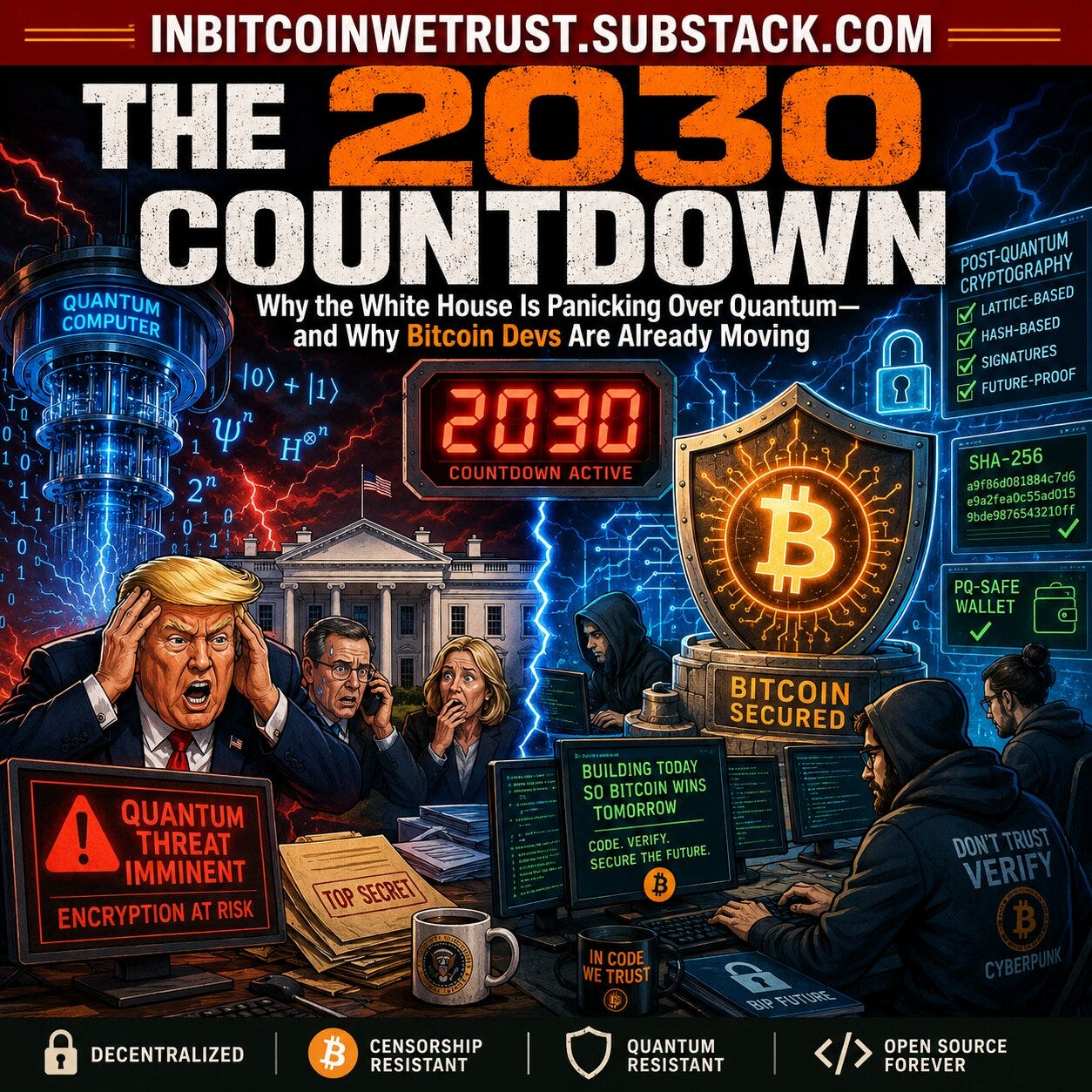
The 2030 Countdown: Why the White House Is Panicking Over Quantum—and Why Bitcoin Devs Are Already Moving.
President Trump’s sweeping new executive order just validated Bitcoin's ultimate threat model. Here is how the cypherpunk defense is outracing the state—and what you must do to protect your stack.
🌞 Summer 2026 Special Offer: Unlock 10 Years of Bitcoin Insights + 2 Free Books.
10 Years of Bitcoin History and Strategy, Now at Your Fingertips.
Fellow Bitcoiners,
We often talk about the difference between the slow, reactive nature of the fiat system and the proactive, antifragile nature of the Bitcoin protocol. Yesterday, that contrast was put on full public display on the global stage.
On June 22, 2026, President Trump signed the executive order, “Securing the Nation Against Advanced Cryptographic Attacks.” The mandate is sweeping and absolute: all federal agencies must migrate their high-value systems to post-quantum cryptography (PQC) with a hard deadline of December 31, 2030, for key establishment, and December 31, 2031, for digital signatures.
To the mainstream financial media, this is a dense cybersecurity story. To those of us in the Bitcoin ecosystem, this is a massive, flashing neon sign.
The federal government has just officially codified the exact threat model that Bitcoin Core developers have been quietly, ruthlessly building defenses against for months.
While bureaucrats are just now forming committees to understand the quantum threat, the cypherpunk community is already shipping code. BIP-360 (quantum-resistant addresses) and BIP-361 (the post-quantum migration strategy) have been active in the developer ecosystem since early 2026.
The narrative is clear: Bitcoin’s notorious paranoia was, once again, simply foresight. But while the developer tooling is ahead of the federal mandate, the governance and consensus challenges facing the Bitcoin network over the next four years are monumental.
Today, we are going to dive deep into what this executive order means for the broader ecosystem, the technical reality of Bitcoin’s quantum threat, the grueling consensus battles ahead over Satoshi’s coins, and—most importantly—what you need to do to protect your wealth.
The Quantum Civil War: How the Threat to Bitcoin's Cryptography is Forcing a Reckoning on Self-Sovereignty.

As we navigate the turbulence of mid-2026, the global macroeconomic backdrop has never been more precarious. With the United States national debt cresting past the staggering $40 trillion mark, the long-theorized Triffin Dilemma is no longer an academic abstraction
The “Harvest-Now, Decrypt-Later” Reality
To understand why the fiat government is panicking—and why Bitcoin developers have been moving with uncharacteristic speed—you must understand the specific attack vector.
The threat is not that a working, large-scale, fault-tolerant quantum computer exists today. If it did, the global financial system would already be in ruins. The threat is that data captured today will be cracked tomorrow. This is known in cryptographic circles as the harvest-now, decrypt-later attack.
Adversaries, specifically state-sponsored intelligence agencies, are currently scooping up vast amounts of encrypted data traversing global networks. They cannot read it yet because it is secured by traditional public-key cryptography like RSA or the Elliptic Curve Digital Signature Algorithm (ECDSA). But storage is cheap. These state actors are warehousing exabytes of encrypted communications, financial transactions, and intelligence data.
They are patiently waiting for “Q-Day”—the day a quantum computer becomes powerful enough to run Shor’s algorithm, which can break the math underlying ECDSA in minutes. When that day arrives, every piece of historical data harvested over the past decade instantly becomes plaintext.
President Trump’s executive order explicitly names this threat:
“Adversaries collecting United States information now, and decrypting it later once large-scale quantum computers are operational.”
By establishing a 2030 deadline, the federal government is drawing a line in the sand. Any secret that needs to remain secret past the 2030s must be encrypted using post-quantum algorithms today.
The Post-Quantum Dawn: Bitcoin, BIP-360, and the War of Signatures.

The history of cryptography is a perpetual arms race. Since Bitcoin’s inception in 2009, an invisible Sword of Damocles has hung over the network: quantum computing. Long relegated to the realm of science fiction or a distant horizon, this technological threat is beginning to cast a concrete shadow over the security of global financial systems.
