
The Post-Quantum Dawn: Bitcoin, BIP-360, and the War of Signatures.
From the P2MR shield to the SPHINCS+ revolution: An in-depth look at how the network is arming itself against the inevitable quantum threat.
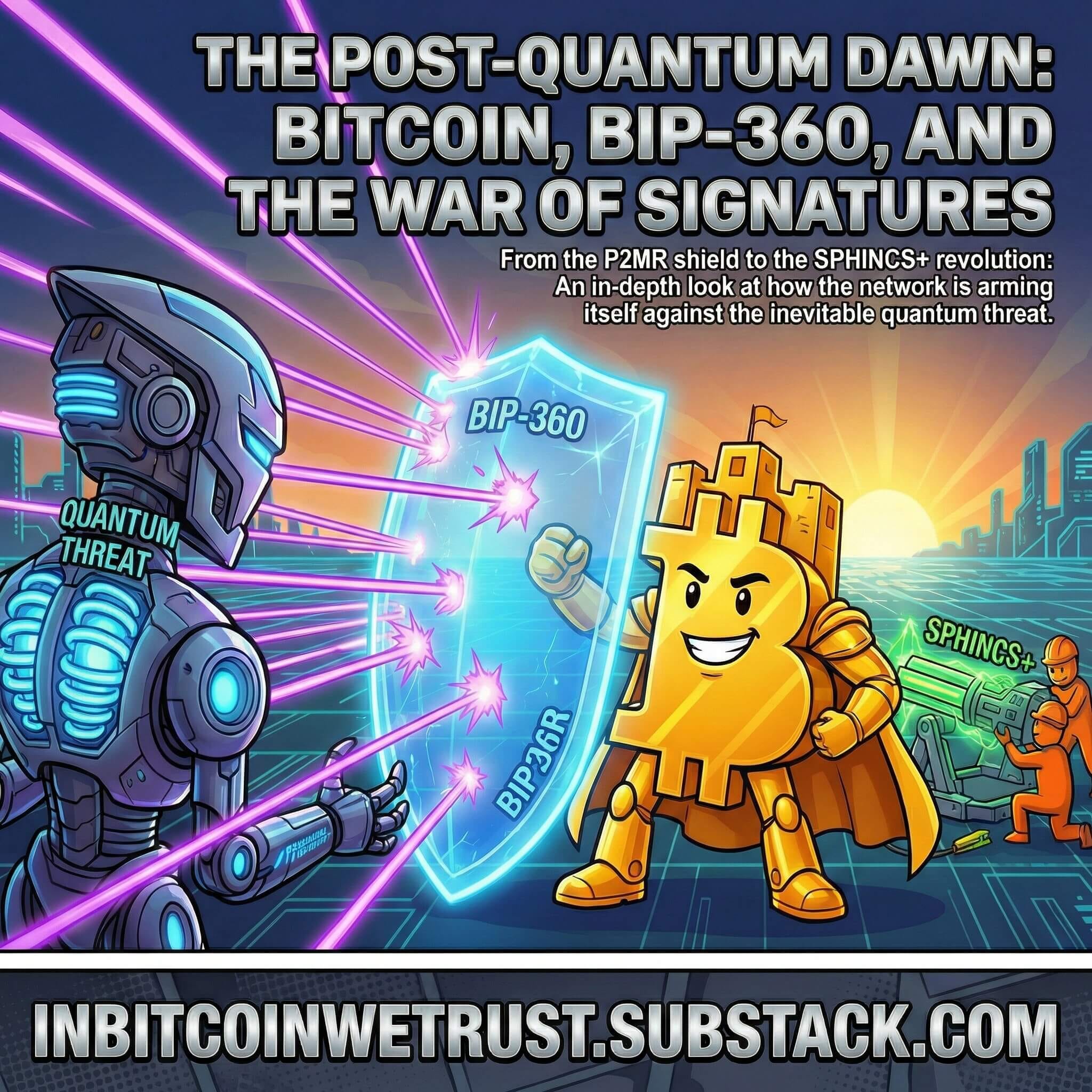
The history of cryptography is a perpetual arms race. Since Bitcoin’s inception in 2009, an invisible Sword of Damocles has hung over the network: quantum computing. Long relegated to the realm of science fiction or a distant horizon, this technological threat is beginning to cast a concrete shadow over the security of global financial systems. Today, Bitcoin’s response is taking shape with BIP-360, but the real battle will be fought on the terrain of digital signatures.
This is not just a technical update; it is an architectural paradigm shift. Facing the existential risks posed by the exponential computing power of Qubits, BIP-360 introduces an elegant mechanism to protect certain transactions. While it is not the definitive “silver bullet,” it constitutes the first bulwark, the first fortified line of defense for a digital citadel preparing for a siege.
I. The Specter of the Quantum Apocalypse
To understand the importance of BIP-360 and future solutions like SPHINCS+, one must first grasp the nature of the threat. Bitcoin’s security currently relies on Elliptic Curve Cryptography (ECDSA) and Schnorr signatures (introduced with Taproot). These algorithms are unbreakable for our current classical supercomputers. It would take the most powerful computer in the world billions of years to deduce a private key from a public key.
However, quantum computing changes the rules of the game. By utilizing the properties of superposition and quantum entanglement, a specific algorithm—Shor’s algorithm—could theoretically break these mathematical problems in a few hours, or even minutes.
