
The Great Inversion: Why Money Isn't "Backed" By Trust, It's Enforced By It.
Bitcoin is a “thermodynamic” money. Its integrity is guaranteed by the laws of physics and the prohibitive cost of energy.
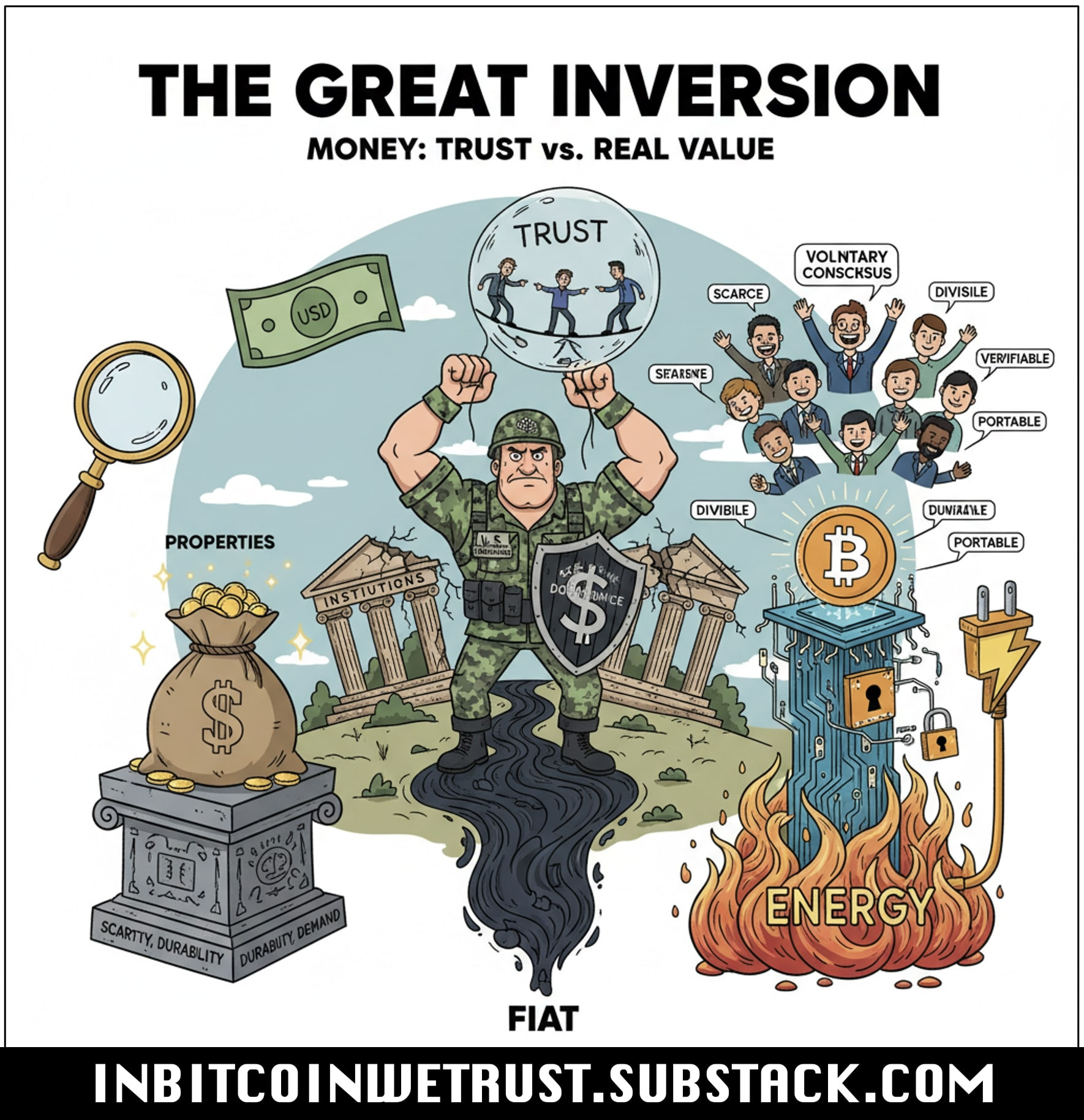
Let me tell you something strange about money: The more people “trust” it, the less it’s actually backed by anything real.
This statement feels like a riddle, a paradox that unravels the moment you pull on its threads. We are taught to believe that our financial system runs on trust. We “trust” the bank to hold our deposits. We “trust” the government to manage the currency. We “trust” that the piece of paper (or, more likely, the digital entry) in our account will be worth roughly the same tomorrow as it is today.
But this modern “trust” is a phantom. It’s an inversion of what monetary trust used to mean. Traditionally, “backed” was a physical concept. It meant that the currency in question, whether a paper note or a clay token, was a claim check. It was a promise that you could, at any time, walk up to the issuer and exchange that token for a predefined amount of something tangible and universally valued—most often, gold or silver.
The trust wasn’t in the promise itself; it was in the redeemability of that promise. The value was anchored to something real.
Today, we find ourselves in a very different world. The anchors have been cut, and our entire global financial system is adrift on an ocean of pure, unadulterated faith.
Let’s dissect this illusion.
The Great Divergence: Why Gold's $4,300 Surge and Bitcoin's Stall Is the U.S. Endgame.

It’s the story no one on Wall Street or in Washington wants to admit is being written. In 2025, the financial world is witnessing a great divergence, a tectonic shift that defies a decade of programming.
The Age of Trust and Enforcement: The Dollar Dilemma
What about the U.S. Dollar, the bedrock of the global economy? Is the USD “backed” by something?
No.
It used to be. For much of its history, the dollar was tied to gold. You could, in theory, exchange your dollars for a fixed amount of gold bullion. This tether, however imperfect, placed a hard limit on the creation of new money. A government couldn’t just print more dollars without acquiring more gold, a substance notoriously difficult to create.
That all ended on August 15, 1971. In what became known as the “Nixon Shock,” President Richard Nixon unilaterally severed the final link between the U.S. dollar and gold. The gold window was “temporarily” closed. That temporary measure is now over half a century old.
So, what has backed the dollar since 1971?
Keep reading with a 7-day free trial
Subscribe to In Bitcoin We Trust Newsletter to keep reading this post and get 7 days of free access to the full post archives.