
Inside validation.cpp: The Heart of the Bitcoin Core Consensus Engine.
A Hardcore C++ Source Code Review of State Transitions, UTXO Cache Management, and the Cryptographic Arbitrator of Truth.

If you look at the thousands of files inside the Bitcoin Core repository, you will find code that handles the peer-to-peer network, wallet key management, RPC interfaces, and graphical user interfaces. While all of these are necessary for a functional client, they are ultimately secondary. You can strip away the GUI, tear out the wallet, and replace the networking stack, and you will still have Bitcoin.
But if you alter a single line of logic inside src/validation.cpp, you are no longer running Bitcoin. You have hard-forked yourself off the network.
validation.cpp (along with its closely associated files like consensus/tx_verify.cpp and coins.cpp) is the undisputed heart of the Bitcoin Core consensus engine. It is the Supreme Court of the protocol. When a new block arrives from a peer, this file is responsible for dissecting it, verifying its cryptographic proofs, executing its smart contracts (Bitcoin Script), and updating the global ledger—the Unspent Transaction Output (UTXO) set.
The stakes in this file are astronomical. A single logical error, a misplaced boolean operator, or a memory mismanagement flaw here can lead to chain splits, catastrophic inflation bugs (such as the infamous CVE-2018-17144), or network-wide Denial of Service (DoS) attacks.
This deep dive is written for systems engineers, C++ developers, and hardcore Bitcoin protocol researchers. We are going to open the hood of Bitcoin Core, tear down the architecture of validation.cpp, explore how the UTXO database interacts with system memory, and break down the legendary ConnectBlock() function line by line. Finally, we will compile Bitcoin Core from source with debugging symbols, attach the GNU Debugger (GDB), and step through a live transaction validation on Regtest.
Welcome to the absolute bare metal of decentralized consensus.
The Siren Song of "3 Bitcoin to Retire": Why You're Missing the Point.

You’ve seen the charts. They splash across your social media feed with tantalizing headlines: “How Much Bitcoin You’ll Need to Retire in 2035.” The numbers are always shockingly small. One Bitcoin. Maybe three. The implication is clear: buy a few digital coins, sit back, and wait for the Lambo to arrive at the doorstep of your beach house.
Part 1: The Architecture of the State Machine
At its most fundamental level, Bitcoin is a replicated state machine.
The State is the UTXO set (the cryptographic record of who owns what).
The State Transition Function is the block (a batch of transactions).
The Engine evaluating that transition is
validation.cpp.
To ensure that nodes running on Raspberry Pis can remain synchronized with enterprise-grade mining farm nodes, the state transition function must be highly optimized, deterministically reproducible, and fiercely defended against edge cases.
In modern Bitcoin Core architecture, the validation process is bifurcated to separate network-layer spam from actual consensus logic. When a block arrives via the P2P network, it must pass through a gauntlet of checks. These checks are divided into three distinct phases:
Context-Free Validation (
CheckBlock/CheckTransaction): Can be verified immediately without knowing the current state of the blockchain.Contextual Validation (
ContextualCheckBlock): Requires knowledge of the blockchain’s history, but not the specific UTXO set.State Application (
ConnectBlock): Requires complete access to the UTXO set and results in a permanent state mutation.
Before we dive into these functions, we must understand the database structure that makes validating 4,000+ transactions per second physically possible on consumer hardware.
The Phantom Film of Wall Street: How a 32-Year-Old Paul Tudor Jones Predicted Black Monday, Made $100 Million, and Tried to Erase the Evidence.

Inside the buried 1987 documentary that proves the ultimate secret to conquering the market isn’t playing great offense—it’s mastering the ruthless discipline of survival.
Part 2: The UTXO Set and LevelDB (CCoinsView)
Bitcoin does not have “accounts” or “balances.” It has a massive cryptographic database of locks (UTXOs). To validate a transaction, validation.cpp must prove that the input trying to spend a coin is authorized to unlock it, and that the coin has not already been spent.
Scanning the entire 500+ GB blockchain for every transaction is impossible. Instead, Bitcoin Core maintains the Chainstate Database—a highly optimized LevelDB instance located in the chainstate/ directory of your node.
LevelDB is a fast, key-value storage engine written by Google. In Bitcoin, it is used to map transaction outputs to their unspent status.
The Chainstate Database Schema
The LevelDB database relies on specific byte prefixes to organize its keys:
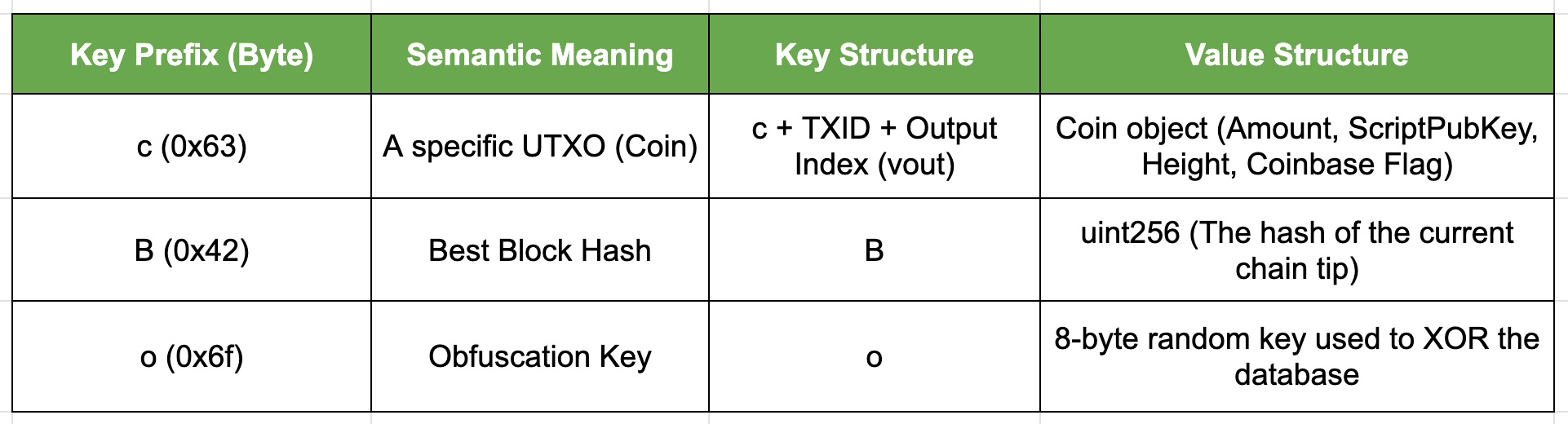
The Obfuscation Key: The
oprefix stores an 8-byte XOR key. Bitcoin Core XORs all UTXO data before writing it to LevelDB. This is a brilliant engineering hack to prevent overzealous anti-virus software from detecting “malware signatures” arbitrarily embedded in raw blockchain data and quarantining the node’s database.
The UTXO Cache Hierarchy (CCoinsViewCache)
Reading from and writing to a physical disk (even an NVMe SSD) for every single input in a block would destroy node performance. To achieve maximum throughput, Bitcoin uses a polymorphic cache hierarchy centered around the CCoinsView class interface.
The hierarchy looks like this:
CCoinsViewDB: The lowest level. It directly wraps the LevelDBchainstateon disk.CCoinsViewBacked: A wrapper that allows one view to read from another.CCoinsViewCache: An in-memory cache sitting on top of a backing view.
When validation.cpp wants to validate a block, it does not touch the disk directly. Instead, it creates a temporary CCoinsViewCache (often called the view).
When a transaction asks, “Does this UTXO exist?”, the node checks the in-memory cache. If it’s a cache miss, it queries the disk (CCoinsViewDB), loads the UTXO into the cache, and then performs the script verification. If the transaction is valid and spends the coin, the coin is marked as DIRTY (modified) and SPENT in the cache.
These changes are kept entirely in RAM. Only when the cache exceeds its memory limit (-dbcache in the config file, default 450 MB) or a new block arrives, does validation.cpp trigger a “flush,” writing all the DIRTY coins down to LevelDB in one massive, optimized batch operation.
When Fiat Fails the Vulnerable: Why Bitcoin is the Only True Lifeline.

I spend a lot of time in this newsletter dissecting macroeconomic trends, analyzing hash rates, and tracking institutional adoption. But today, we are stepping away from the charts to talk about the absolute core of why Bitcoin exists. We are talking about what happens when the legacy financial system completely abandons the people who need it most.
Part 3: Phase 1 - Context-Free Validation (CheckBlock)
When a block is handed to validation.cpp, the first function invoked is CheckBlock(). This function operates in a vacuum. It does not look at the UTXO set and does not know the current block height. Its sole purpose is to quickly discard malformed, structurally invalid, or mathematically impossible blocks before they waste valuable CPU cycles and memory.
Here is the exact gauntlet CheckBlock() runs:
