
Bitcoin Vaults: The Technical Blueprint for Making Self-Custody Safer After a Key Leak.
How Bitcoin vaults could transform self-custody from a fragile key-management problem into a layered security system built for theft, recovery, and long-term sovereignty.
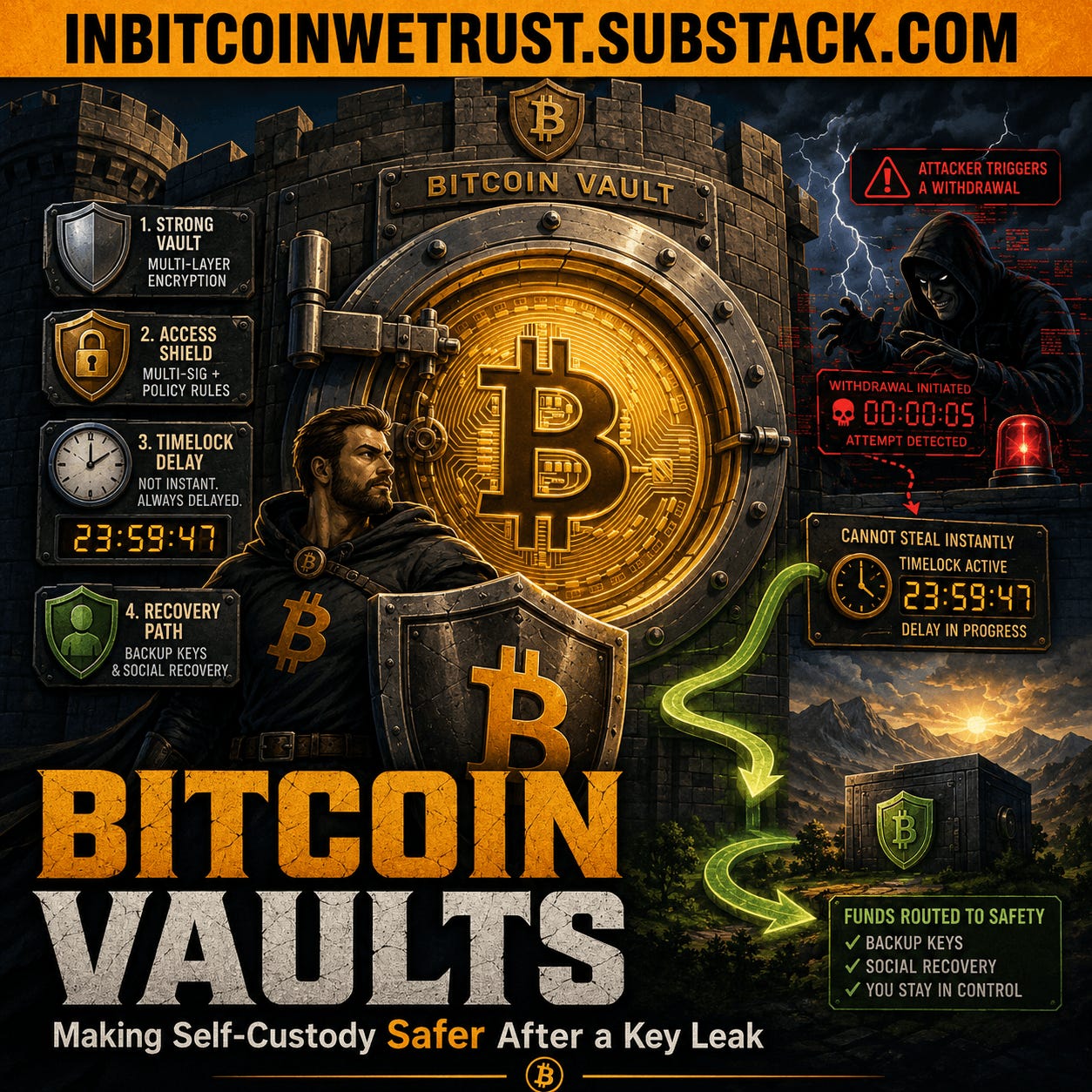
Most people think Bitcoin security is about keeping your private key secret. That is true, but it is not the whole truth. The deeper truth is more uncomfortable: once your key is compromised, Bitcoin gives you very little time to react. There is no fraud department to call. No bank manager to freeze the wire. No password reset. No “suspicious activity” button. No customer service desk where you can prove your identity and reverse the transaction.
Bitcoin is a final settlement. That is its superpower. It is also the reason self-custody can be terrifying. For years, Bitcoiners have repeated the same mantra: not your keys, not your coins. It is a good mantra. It is also incomplete. Because after someone finally takes possession of their own keys, a second question appears: Now what?
How do you protect those keys from theft?
How do you protect them from loss?
How do you protect them from yourself?
How do you protect your family if something happens to you?
How do you protect a business treasury from a single compromised device, a dishonest employee, a supply-chain failure, a phishing attack, or a $5 wrench attack?
The basic Bitcoin wallet gives you one brutal security model: whoever can sign can spend. That model is simple, powerful, and beautiful. But it is not always enough. A Bitcoin vault tries to add something that normal private-key custody does not have: time. Not trust. Not a custodian. Not a third party with veto power over your money. Time.
A Bitcoin vault is a way to make spending from cold storage slower and safer by forcing withdrawals through a delay period. If a thief steals the key used to initiate a withdrawal, the coins do not immediately disappear. Instead, the attempted withdrawal becomes visible. The owner has a window of time to notice the attack and redirect the coins to a safer recovery path.
A normal Bitcoin wallet says, “If you have the key, you can spend.”
A vault says: “If you have the key, you can start the spend — but the coins do not leave immediately, and the real owner may still have a chance to stop you.”
This is a huge conceptual shift. It turns Bitcoin custody from a purely preventive system into a reactive security system. Preventive security says: never let the attacker get the key. Reactive security says: if the attacker gets one key, the system should still give you a chance to survive. That difference matters because in the real world, perfect prevention is a fantasy.
The Silent Guardian: How Bitcoin Time-Locking Solves the Self-Custody Dilemma.

In the world of Bitcoin, there is a pervasive anxiety that lurks beneath the surface of “being your own bank.” It is the fear of the single point of failure. We preach self-custody, we memorize seed phrases, and we buy steel plates to protect our backups from fire and flood. Yet, a nagging question remains in the back of our minds:
The self-custody problem nobody likes to talk about
Bitcoiners are right to criticize custodians.
Custodians can fail. Custodians can lie. Custodians can rehypothecate. Custodians can freeze withdrawals. Custodians can be hacked. Custodians can be pressured by governments. Custodians can turn your bearer asset into an IOU with a nice app interface.
If you have lived through enough Bitcoin cycles, you have seen this movie repeatedly: “trusted” platforms implode, users discover that their coins were never really there, and the market learns the same lesson again.
Self-custody is the answer. But self-custody has its own hard truth: it moves responsibility from the institution to you. That sounds empowering until your house floods, your hardware wallet dies, your seed backup is unreadable, your spouse cannot find your instructions, your multisig coordinator disappears, or you realize that your entire financial life depends on a few words stamped into metal.
The self-custody challenge has two enemies: theft and loss. If you make your setup too easy to spend from, the theft risk rises. If you make your setup too hard to spend from, the risk of loss rises. This is the custody paradox. A hot wallet is convenient but exposed. A deep cold wallet is secure but operationally difficult. Single-signature storage is simple but brittle. Multisig is stronger but more complex. Adding a passphrase can protect against seed compromise, but it can also become another way to lock yourself out forever. Geographic distribution protects against fire and theft, but it complicates recovery. Inheritance planning protects your family, but it may reveal too much information to the wrong people too early.
Every serious custody setup is a tradeoff. Bitcoin vaults do not eliminate this tradeoff. They add a new tool. And it may be one of the most important tools for the next era of Bitcoin self-custody.
The Most Expensive Advice in History: The $1.5 Trillion Paradox.

Warren Buffett convinced Bill Gates to diversify his Microsoft portfolio. It was a masterclass in wealth preservation that ultimately cost the founder $1.4 trillion.
What a Bitcoin vault is, in plain English
Imagine you store most of your Bitcoin in a highly secure cold wallet.
You do not want to touch it every day. You do not want it connected to the internet. You do not want the key sitting on your phone. You do not want one compromised device to drain your life savings.
But you still need a way to spend eventually. Maybe you want to move coins to a hot wallet. Maybe you want to rebalance your storage. Maybe a business wants to pay expenses. Maybe a family wants a long-term inheritance plan.
A vault creates a structured process for moving coins. Instead of allowing an instant withdrawal, the vault requires two stages. First, someone triggers a withdrawal. This transaction signals: “These coins are scheduled to move.” Then a delay begins. The delay might be measured in blocks or time. During this period, the coins are not yet fully gone. The owner, or software watching on the owner’s behalf, can detect that a withdrawal has been initiated. If the withdrawal is legitimate, the owner waits out the delay and completes it. If the withdrawal is unauthorized, the owner activates a recovery path and moves the coins to a safer destination.
This is why vaults are often described as giving you a “clawback” window. That word can be misunderstood. It does not mean reversing an already-confirmed final payment after coins have been freely spent. Bitcoin finality is still Bitcoin finality. What it means is that the vault design intentionally makes spending a multi-step process. During the intermediate stage, before final withdrawal, the owner can redirect funds to a recovery path. The thief may have enough access to start trouble, but not enough to complete the theft immediately. That is the magic.
Your First Programmable Bitcoin Wallet: A Step-by-Step Guide to Building a "Dead Man's Switch" with Liana.

For years, the mantra of Bitcoin has been “not your keys, not your coins.” We have trained ourselves to be hyper-vigilant custodians of 12 or 24 words. We etch them into steel, hide them in buried PVC pipes, and memorize them until we can recite them backwards.
