
Beyond the Headlines: A Comparative Analysis of Energy Consumption in Bitcoin, Traditional Banking, and Gold Mining.
Exposing the Hidden Devastation of Fiat and Gold—and Why Proof-of-Work is the Most Efficient Monetary Network in Human History.
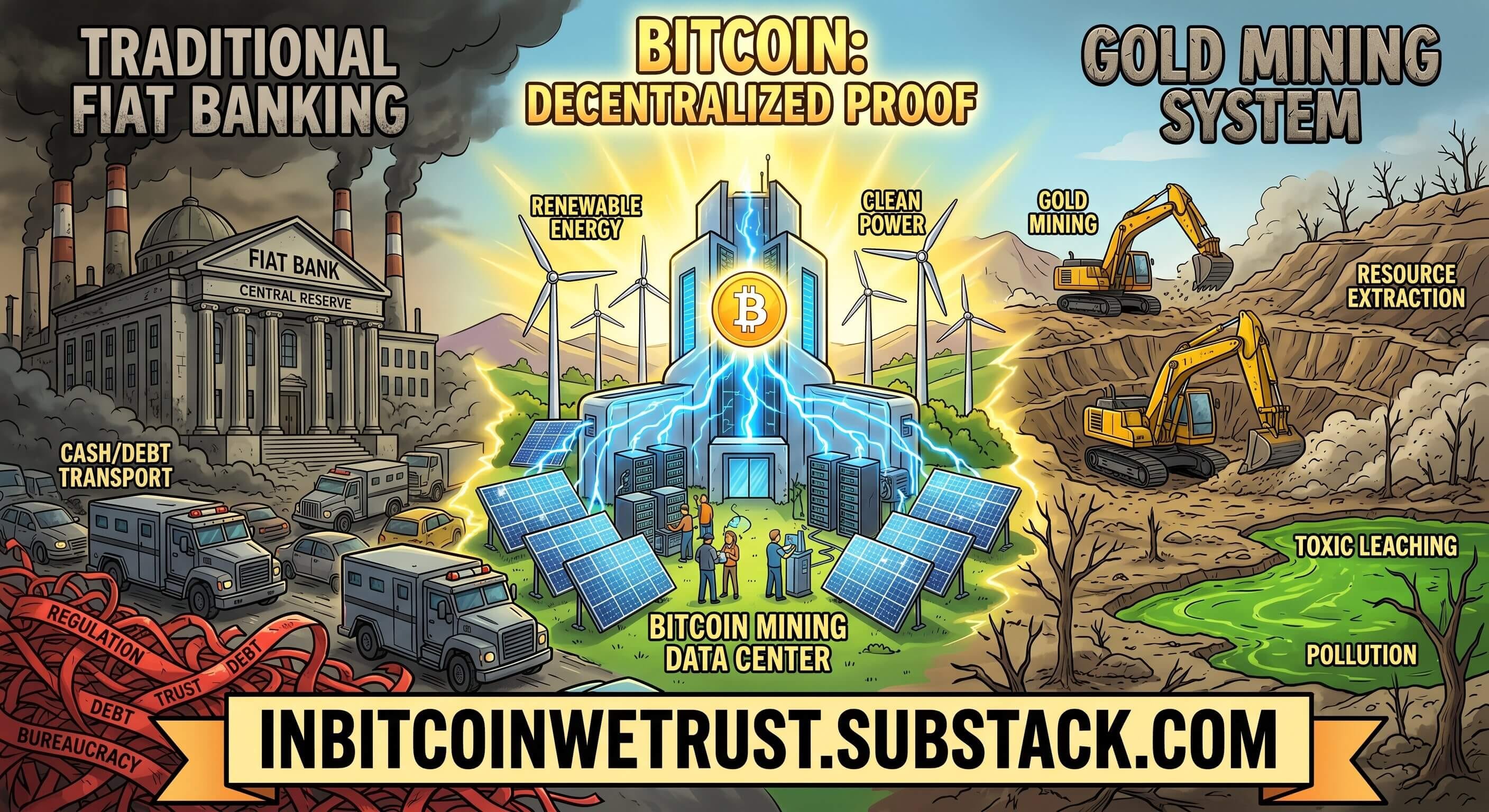
The debate surrounding Bitcoin’s environmental impact is undeniably one of the most heavily sensationalized, fiercely polarized, and widely misunderstood topics in the modern financial world. Mainstream media critics and traditional economists frequently argue that Bitcoin’s energy consumption represents an existential threat to the planet, characterizing it as a wasteful, resource-draining vestige of a speculative digital mania. They look at the terawatt-hours consumed and immediately declare a climate emergency.
However, this superficial critique completely misses the fundamental scientific, economic, and thermodynamic breakthrough that Bitcoin represents. Proponents correctly counter that this energy expenditure is not a flaw, a bug, or a waste, but rather the essential, unforgeable cost of securing the world’s first truly decentralized, trustless, and immutable financial network.
To find clarity and arrive at the truth, we must aggressively move beyond simplistic soundbites, clickbait headlines, and flawed methodologies. We must conduct a rigorous, intellectually honest comparative analysis. We must place Bitcoin’s transparent energy use alongside the opaque, sprawling, and historically unquestioned systems it aims to complement and ultimately disrupt: the vast, inefficient global fiat banking infrastructure and the ancient, Earth-scarring, resource-intensive gold mining industry.
When we evaluate not just the absolute energy consumed but the fundamental utility, efficiency, and environmental impact of these three distinct systems, a definitive truth emerges from the data. The incumbent systems are not only vastly more destructive to our physical world, but they also offer diminishing returns in an increasingly digital age. In the final calculus of energy expenditure versus societal value, Bitcoin stands unparalleled. It is the clear, undisputed winner.
Part 1: The Bitcoin Energy Paradigm — The Cost of Digital Immutability
Bitcoin’s energy usage is not an accident; it is the deliberate, mathematically enforced cornerstone of its entire security model, known as Proof-of-Work (PoW). To understand why Bitcoin’s energy footprint is a revolutionary feature rather than a bug, we must first understand the critical role that energy plays in maintaining the integrity of the network and protecting the wealth of millions.
The Incorruptible Mechanism of Proof-of-Work
In a legacy centralized system like a commercial bank, a central authority—a CEO, a board of directors, or a government bureaucrat—manages the ledger of transactions. They hold the power to freeze accounts, reverse transactions, and dilute the currency supply. In Bitcoin, there is no central authority, no CEO, and no central point of failure. Instead, thousands of independent, geographically distributed computers (miners) compete in a free market to maintain and validate the ledger.
This competition requires miners to solve incredibly complex cryptographic hashing algorithms using specialized, high-powered computing hardware known as Application-Specific Integrated Circuits (ASICs). This process undeniably consumes substantial amounts of electricity. When a miner successfully solves the cryptographic puzzle, they earn the right to add the next “block” of verified transactions to the blockchain, receiving a reward in newly created Bitcoin and transaction fees.
The high energy cost creates an impenetrable physical wall around the network. To alter the blockchain’s history—to execute a so-called 51% attack and double-spend coins—an attacker would need to physically acquire and power more than half of the entire global network’s computational capacity. This would require an astronomical, practically impossible amount of energy and hardware. By tying the digital ledger directly to the physical laws of thermodynamics, Bitcoin achieves unforgeable costliness. You cannot fake the energy burned. Therefore, you cannot fake the ledger.
Radical Transparency vs. Intentional Opacity
One of Bitcoin’s greatest strengths in this debate is its radical transparency. Unlike the legacy financial sector or the global gold supply chain, Bitcoin’s energy consumption is an open book. Because the entire network operates on a public, open-source protocol, researchers at institutions like the Cambridge Centre for Alternative Finance (CCAF) can calculate the network’s total hash rate (computational power) in real-time, 24 hours a day, 365 days a year.
From this public data, anyone can derive highly accurate estimates of the network’s energy consumption. This transparency allows for an evidence-based debate. Bitcoin is penalized in the court of public opinion simply because it is the only global financial system that provides an exact, auditable receipt of its energy bill. The legacy systems hide their massive consumption behind closed doors, complex supply chains, and obfuscated corporate reporting.
The Buyer of Last Resort: Rescuing Stranded Energy
The absolute number of terawatt-hours (TWh) consumed per year is only a fraction of the story. The source and location of that energy dictate its true environmental impact. Bitcoin mining is a highly unique industry: it is entirely location-agnostic and completely interruptible. A miner only needs an internet connection and a power source. They do not need to be near a major city, a port, or a consumer base.
Because mining operates on razor-thin profit margins, miners are economically incentivized to scour the globe for the absolute cheapest electricity. In the global energy market, the cheapest energy is always the energy that no one else can use—often referred to as “stranded” energy.
Curtailed Renewables: In regions with abundant hydro, solar, or wind power—such as parts of Texas, Northern Europe, and rural Africa—energy production frequently exceeds local grid demand. Because electricity is incredibly difficult and expensive to store or transport over long distances, this excess renewable energy is completely wasted, or “curtailed.” Bitcoin miners set up directly at the source to soak up this wasted, clean energy. By acting as a guaranteed buyer of last resort, Bitcoin actually subsidizes the development of new green energy infrastructure, making renewable projects economically viable where they previously were not.
Grid Balancing: Because ASICs can be powered down in a matter of seconds, Bitcoin miners serve as the ultimate grid-balancing tool. During events like extreme winter storms or summer heatwaves in Texas (governed by ERCOT), miners voluntarily shut off their machines, instantly returning hundreds of megawatts of power to the grid to heat homes and save lives. No other major industrial consumer of electricity can power down so rapidly without damaging their operations.
Methane Mitigation: Perhaps the most powerful environmental argument for Bitcoin is its role in capturing stranded natural gas. During oil extraction, natural gas is often a byproduct. If the oil well is far from a pipeline, it is economically unfeasible to transport the gas, so oil companies simply set it on fire—a process called “flaring.” Flaring releases immense amounts of carbon dioxide and unburned methane (a greenhouse gas over 80 times more potent than CO2 in the short term) directly into the atmosphere. Today, innovative Bitcoin mining companies are placing mobile mining units directly on oil pads. They capture the gas that would otherwise be flared, pipe it into generators, and use the electricity to mine Bitcoin. This process combusts the methane far more efficiently than an open flare, drastically reducing the carbon-equivalent emissions. Bitcoin is literally cleaning the atmosphere while securing a financial network.
Part 2: The Hidden Leviathan — The Sprawling Waste of Traditional Banking
To truly understand the efficiency of Bitcoin, we must confront the staggering, hidden leviathan of the traditional fiat banking system. Quantifying the energy footprint of the global banking sector is an order of magnitude more complex than measuring Bitcoin because “banking” is not a single, streamlined process. It is a vast, fragmented, heavily bureaucratic, interconnected ecosystem that touches almost every facet of the physical world.
When critics complain about a Bitcoin transaction, they fail to visualize the monumental physical infrastructure required to process a single credit card swipe or an international wire transfer. The fiat system is an energy black hole.
The Brick-and-Mortar Behemoth
The most visible component of the legacy financial system is its sprawling real estate portfolio. Worldwide, there are hundreds of thousands of physical bank branches. Consider the energy footprint of just this single layer of the fiat ecosystem:
Construction and Maintenance: The concrete, steel, glass, and heavy machinery required to build these structures represent a massive sunk energy cost.
Daily Operations: Millions of bank branches require 24/7/365 electricity for lighting, security systems, heavy vault doors, and continuous heating, ventilation, and air conditioning (HVAC).
The Corporate Skyscrapers: Look at the skyline of New York, London, Frankfurt, or Tokyo. The largest, most energy-hungry skyscrapers belong to commercial banks, central banks, and financial institutions (JPMorgan Chase, Goldman Sachs, HSBC). Powering these mega-structures consumes exorbitant amounts of energy.
The Human Commute: A Hidden Carbon Catastrophe
Unlike Bitcoin, which is entirely automated by code, the fiat banking system requires massive human intervention. There are tens of millions of people employed in the global banking and financial services sector.
Every single day, these millions of employees wake up, heat their homes, get into gasoline-powered cars, or take public transit, and commute to physical offices. The carbon emissions and energy expenditure required simply to transport the workforce of the fiat financial system to their desks every morning are astronomical. Bitcoin requires zero human commuters to process transactions, clear settlements, or secure its network.
The Physical Currency Ecosystem
The traditional system still relies heavily on the continuous production and transportation of physical cash, which requires heavy industrial processes:
The Printing Presses and Mints: Central banks and treasuries operate massive industrial printing presses and metal mints. They harvest cotton and linen, produce specialized anti-counterfeit inks, and mine base metals like zinc, copper, and nickel simply to create the physical tokens of fiat money. This is an endless cycle, as old bills are constantly shredded and replaced.
Armored Logistics: Physical cash must be securely transported. This requires a global fleet of heavily armored, low-gas-mileage, diesel-guzzling trucks operated by companies like Brinks and GardaWorld. These trucks are constantly moving billions of dollars between central banks, commercial branches, and retail stores, burning millions of gallons of fossil fuels daily.
The ATM Network: There are over 3 million Automated Teller Machines (ATMs) worldwide. Each machine is essentially a heavy, specialized computer that requires continuous electricity, cellular/internet connections, thermal regulation (heating in winter, cooling in summer), physical maintenance, and paper receipt rolls.
The Inefficient Digital Backend
When you move away from cash, the digital fiat system is barely more efficient. It relies on a tangled web of legacy mainframes and redundant data centers. A single cross-border payment might pass through a local bank, a national clearinghouse, the SWIFT network, correspondent banks, and the receiving central bank. Each of these entities maintains its own massive, energy-intensive server farms. Because they do not share a single unified ledger (like Bitcoin), they must constantly reconcile their databases with one another, requiring vastly more computational overhead than is necessary.
The Ultimate Energy Backing: The Petrodollar and the Military
Finally, we must address the unspoken foundation of fiat money. Fiat currency—specifically the US Dollar, the world’s reserve currency—is not backed by nothing. It is backed by the threat of state violence.
The maintenance of the “Petrodollar” system—ensuring that global energy is traded in dollars—requires the projection of military power. The US Department of Defense is the single largest institutional consumer of petroleum in the world. The fleets of aircraft carriers, fighter jets, tanks, and global military bases required to maintain the geopolitical dominance that underpins the fiat banking system represent a carbon footprint that dwarfs Bitcoin entirely.
When compared to the sprawling, bureaucratic, physically destructive, and violently backed fiat system, Bitcoin’s elegant, mathematical, and entirely peaceful energy consumption is a masterclass in efficiency.
The Quantum Supercomputer is Moving In.

Why the perpetual “ten years away” framing is dead, and what the integration of classical and quantum hardware means for the future of infrastructure.
Part 3: The Earth-Scarring Reality of Gold Mining
For five millennia, gold has been the premier store of value for human civilization. Its value is fundamentally derived from its physical scarcity and the extreme difficulty and energy required to extract it from the Earth’s crust. While “digital gold” (Bitcoin) is criticized for its electrical use, physical gold mining is an ongoing environmental catastrophe that permanently scars the planet.
Gold mining is a purely industrial, heavy-machinery-driven process that consumes immense amounts of fossil fuels and toxic chemicals. When we examine the lifecycle of a single ounce of gold, the environmental argument for Bitcoin becomes overwhelmingly clear.
Moving Mountains for Ounces
Gold is incredibly rare. Today, the “low-hanging fruit” of gold veins has long been depleted. Modern gold mining relies heavily on open-pit mining to extract extremely low-grade ore. To find just a single ounce of gold—enough to make one small coin or a wedding ring—miners often have to blast, excavate, and transport anywhere from 20 to 60 tons of solid rock.
This requires fleets of the largest vehicles ever built by mankind: massive diesel-powered hydraulic excavators and gargantuan haul trucks, some capable of carrying 400 tons of rock at a time. These machines operate around the clock, burning thousands of gallons of diesel fuel every single day, emitting massive plumes of localized air pollution and greenhouse gases.
The Chemical Nightmare: Cyanide and Toxic Tailings
Once the hundreds of tons of ore are extracted, the rock must be crushed into a fine powder in massive, electrically powered mechanical mills. But the true environmental devastation begins during the chemical extraction phase.
To separate microscopic gold particles from the rock, the mining industry relies heavily on cyanide heap leaching. Millions of gallons of water are mixed with highly toxic sodium cyanide and sprayed over mountains of crushed ore. The cyanide binds to the gold, allowing it to be collected.
This process results in massive, highly toxic lakes known as “tailings ponds.” These ponds represent a permanent, existential threat to local ecosystems. If a tailings dam fails—which happens with alarming frequency worldwide—millions of gallons of cyanide-laced sludge flood into local rivers, killing all aquatic life, poisoning drinking water for downstream communities, and destroying agricultural land for generations.
Deforestation, Water Depletion, and Human Rights
The physical footprint of a gold mine requires the complete eradication of the local environment. Forests are clear-cut, natural habitats are destroyed, and local topsoil is stripped away, permanently altering the topography. Furthermore, gold mining is one of the most water-intensive industries on earth, frequently draining local aquifers and leaving indigenous populations without access to clean water.
Additionally, while organized, corporate mining has its massive industrial footprint, a significant portion of global gold is extracted through “artisanal” mining in developing nations. This sector is notoriously plagued by severe human rights abuses, child labor, dangerous working conditions, and the rampant use of toxic liquid mercury to amalgamate gold, which directly poisons the miners and their waterways.
Bitcoin mining, by stark contrast, requires absolutely zero toxic chemicals. It requires zero child labor. It does not strip-mine mountains, it does not poison rivers with cyanide, and it does not clear-cut rainforests. It simply requires electricity and computational hardware, safely housed in warehouses.
The Perpetual Energy Cost of Paranoia
The energy consumption of gold does not stop once it is refined. Because gold is heavy, physical, and highly coveted, protecting it requires a perpetual expenditure of energy.
The vast majority of the world’s investment-grade gold sits entirely useless in subterranean vaults. These vaults require massive concrete bunkers, complex electronic security systems, armed guards, and climate control. Transporting gold internationally requires chartered cargo planes, heavily armed convoys, and immense logistical coordination. All of this expends vast amounts of fossil fuels simply to move heavy metal from a hole in the ground in one country to a concrete hole in the ground in another country.
Bitcoin, conversely, can transport a billion dollars of value across the globe, at the speed of light, with absolute finality, without moving a single physical atom, guarded completely by mathematics rather than men with guns.
Part 4: The Ultimate Verdict — Why Bitcoin is the Clear Winner
When we synthesize the data and look beyond the superficial metrics, the comparison is no longer a debate; it is a landslide victory for Bitcoin. The core of the argument comes down to one metric: Utility and Value Generated per Unit of Energy Consumed.
The Flaw of “Energy per Transaction”
Critics frequently use a deeply flawed metric: dividing Bitcoin’s total energy use by its transaction count to claim each transaction uses thousands of times more energy than a Visa swipe. This is a profound misunderstanding of how Bitcoin works.
Bitcoin is a base-layer settlement network, analogous to the massive central bank wire systems (like Fedwire) or the physical movement of gold bullion, not a consumer credit card network. A single Bitcoin transaction can represent the final, irrevocable settlement of billions of dollars between thousands of parties. Furthermore, with Layer 2 scaling solutions like the Lightning Network, Bitcoin can actually process millions of instantaneous, virtually free transactions per second with negligible additional energy expenditure.
Synthesizing the Data
Let us look at the reality of what the energy buys us across the three systems:
1. Traditional Banking
Energy Source: Heavily dependent on fossil fuels for commutes, real estate, paper money production, armored transport, and data centers.
Environmental Impact: Massive carbon footprint, urban sprawl, physical waste, backed by heavily polluting military infrastructure.
Utility: Excludes billions of unbanked people globally. Subject to inflation, political censorship, freezing of assets, and systemic fractional-reserve collapses. Slow cross-border settlements.
2. Gold Mining
Energy Source: Almost entirely reliant on massive diesel consumption and industrial-scale grid electricity.
Environmental Impact: Catastrophic. Destruction of landscapes, cyanide poisoning of water tables, massive carbon emissions, and severe human rights violations.
Utility: A reliable, inflation-resistant store of value, but physically cumbersome, expensive to verify, incredibly slow to transport, and utterly useless as a medium of exchange in the digital age.
3. Bitcoin
Energy Source: Highly flexible, rapidly transitioning to stranded, curtailed, and renewable energy. It acts as a grid balancer and is actively mitigating potent methane emissions.
Environmental Impact: Zero physical footprint outside of small data centers. Zero toxic chemicals. Zero destruction of natural habitats.
Utility: Provides 8 billion people with instant access to an unseizable, censorship-resistant, mathematically scarce, globally portable store of value and settlement network.
The Supreme ESG Asset
Far from being an environmental disaster, Bitcoin is emerging as the ultimate ESG (Environmental, Social, and Governance) asset.
Environmentally, it is the only global industry economically incentivized to seek out stranded renewable energy and actively destroy leaked methane gas. It monetizes the transition to a green grid by making renewable infrastructure profitable.
Socially, it provides financial inclusion for the billions of people ignored by the legacy fiat banking system. It offers a lifeline to citizens living under hyperinflationary regimes, allowing them to protect their purchasing power without needing permission from a corrupt government.
Governance-wise, it is flawless. It is governed entirely by open-source code and global consensus. There are no corporate bailouts, no hidden inflation metrics, and no backroom deals by central bankers. The rules are equal for everyone, everywhere.
Final Thoughts
The narrative that Bitcoin is an environmental menace is a relic of shallow analysis, perpetuated by legacy institutions threatened by its superior architecture.
When we hold traditional banking and gold mining to the same rigorous standards as Bitcoin, the legacy systems collapse under the weight of their own inefficiency, opacity, and massive physical destruction. Traditional banking is an exclusionary, energy-gluttonous bureaucracy held together by physical infrastructure and state enforcement. Gold mining is a toxic, earth-destroying industrial antiquity.
Bitcoin is fundamentally different. It represents a paradigm shift: the transformation of pure, abundant, often stranded energy into an incorruptible, globally accessible digital bedrock. It provides infinitely more utility to humanity than the legacy systems, while actively driving the transition to cleaner energy grids.
Bitcoin does not waste energy; it preserves it, it secures it, and it democratizes it. In the definitive comparison of global financial networks, Bitcoin is not just a competitor. It is the undeniable, absolute, and clear winner.
The $5.4 Billion Fugazi: How Michael Burry Uncovered the Shadow Machine Funding the AI Boom with Retiree Money.

Inside the 16x-leveraged, offshore shell game hiding billions in Silicon Valley debt—and quietly betting America’s retirement on the lifespan of a computer chip.